What is Autoencoder#
An autoencoder is a type of algorithm with the primary
purpose of learning an “informative” representation of the data that
can be used for different applications by learning to reconstruct a set
of input observations well enough.
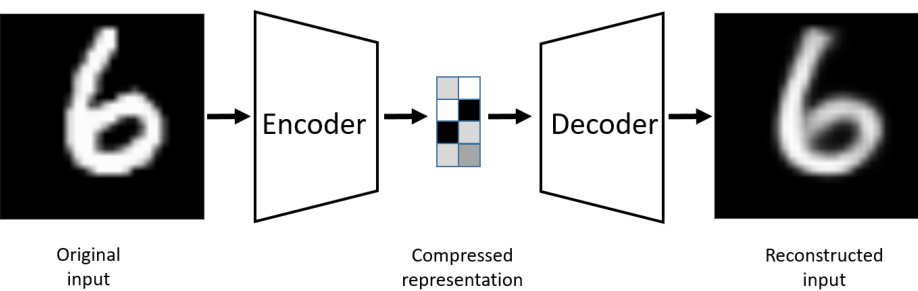
There are three main components in the autoencoders: encoder. latent feature representation and a decoder.
The encoder and decoder are simply functions, while with the name latent feature representation, one typically intends a tensor of real numbers
If Decoder and Encoder are linear model, the autoencoder will achieve same latent presentation of PCA.
to prove:http://toe.lt/1a ↗.
The mission of autoencoder is to learn the functions (encoder) and (decoder) that satisfy
where is the expectation over the distribution of , and is the reconstruction loss function, which measures the distance between the output of the decoder and the intput. The latter is usually set to be the -norm.
Easiest way to realize a autoencoder#
class Encoder(nn.Module):
    def __init__(self, input_dim, feature_dim):
        super(Encoder, self).__init__()
        self.fc = nn.Linear(input_dim, feature_dim)

    def forward(self, x):
        x = torch.relu(self.fc(x))
        return x

class Decoder(nn.Module):
    def __init__(self, feature_dim, output_dim):
        super(Decoder, self).__init__()
        self.fc = nn.Linear(feature_dim, output_dim)

    def forward(self, x):
        x = torch.sigmoid(self.fc(x))
        return x

class Autoencoder(nn.Module):
    def __init__(self, input_dim, feature_dim):
        super(Autoencoder, self).__init__()
        self.encoder = Encoder(input_dim, feature_dim)
        self.decoder = Decoder(feature_dim, input_dim)

    def forward(self, x):
        encoded = self.encoder(x)
        decoded = self.decoder(encoded)
        return decoded